Saturday, June 25, 2022

The Words of One


The words of one can change the minds of many.

            What do you believe? What do you just think you believe, but don’t really, when push comes to shove? People, especially scientists, can get caught up in the intellectual debate and lose sight of what they are trying to prove. Sometimes all it takes is a simple question, asked by a person with unique experience and insight, to get people to examine their core beliefs and, if they are honest, admit they were wrong. I experienced such a moment a few years ago at a Mars exploration meeting hosted by the Lunar and Planetary Institute in Houston, Texas.

            The conference was all about finding innovative new ways to support our exploration of Mars. Being selected to attend was competitive. A call went out for those interested in attending to send in an abstract describing a new approach, technology, or system that could be used in the future exploration of Mars. People submitted ideas for new types of rockets and propulsion systems, creative methods for taking landers and rovers to and from the surface of the planet, new science instruments that were lighter weight or required less power, etc. My abstract described how something called an Electric Sail might be used to reduce the cost and flight time of future robotic spacecraft traveling from Earth to Mars. It was accepted, and I was among the hundreds of scientists and engineers that converged on Houston for the three-day event.

             As is typical for big meetings like this, there was a plenary session on the (space) age old debate, “it is better to explore Mars with robots or people?” There were more than three hundred people attending this plenary, most of whom were space scientists and engineers who, over the last several days, had been presenting or listening to others present their ideas and concepts. Everyone was primed for intellectual sparring.

            The panelists debating the topic were on a stage in the front of the room. The discussion had become heated, with members of each side providing evidence making their case. What struck me was both sides’ seeming inability to understand how anyone could possibly not agree with them. After all, they had presented data supporting their view. Having worked in aerospace for decades, I had heard the arguments and read articles and papers on the topic. Not much new was being said.

            Sitting in front of the auditorium, facing the stage and the panelists, was a single, empty chair with a white sign on its back saying that the seat was reserved for someone with a four-letter name—Buzz. It did not remain empty for long.

            From the front left-side entrance, the person for whom the seat was reserved entered the room. That person was, of course, Buzz Aldrin, the second man to walk on the moon. He paused, for effect I think, before he strode forward and took his seat. Since I was not fully engaged in the debate, and because of who he was, I was distracted from what was being said and watched him instead. Aldrin sat there listening to the debate for no more than five minutes before he rose from his chair.


           When EF Hutton Buzz Aldrin speaks, he gets people’s attention. One by one, the panelists diverted their gazes to him and stopped talking. He was, after all, one of the few people in the world to experience what everyone in the room was discussing – walking on another world. The pause seemed to last a long time, but it was probably only a few seconds. Finally, he broke the silence.

            “I’ve been part of this discussion since I was selected for the astronaut program back in the early sixties. I’ve heard both sides of the debate make their case, but I want to ask a question. I want to ask those watching, not the panelists,” Aldrin turned to speak to us in the audience. Aldrin again paused for a few moments, no doubt to raise a sense of expectation and for the dramatic effect. He then broke the silence with a question.         

            “If it were possible, how many of you would sign up for a one-way trip to Mars?”

            The room was silent, and a few people looked furtively from side to side, waiting on someone else to respond. First, a few hands went up, then more, until finally nearly 70% of the people in the room raised theirs. I was dumbfounded. These were people who fully understood the risks and heard him say it would be a ‘one-way’ trip. It is interesting to note that prior to this, it seemed as if the robots versus people split among the audience was roughly 50/50. Not anymore.

            I did not raise my hand, not because of it being a trip to Mars, but because it would be ‘one way.’ I love the verdant planet upon which we live, my family and friends, and the ability to enjoy the natural world, teeming with life, that is just outside my door. The idea of spending my last days in a pressurized tin can on a desolate world is most definitely not on my list of things to do. Go for a visit and then return to Earth? Sure. But I would not go to Mars and stay.

            When the panel resumed, the debate aspect faded into the background and the topic changed to be something like, ‘we will send robots first, then people.’ This soon became the focus of many discussions and permeated the meeting report that was published afterward.

            To those who follow the history of space exploration, this should not be a surprise. Before we sent Yuri Gagarin and Alan Shepard to orbit the Earth, we sent Sputnik and Laika (the dog). Before Neil Armstrong and Buzz Aldrin went to the Moon, we sent Surveyor (but no mammals). When we finally go to Mars or other solar system destinations, we can be reasonably confident the robots will go there first.

            Once again, as the regular reader of my blog posts might be beginning to understand, I am a passionate believer in the power of the individual. This one man’s (Buzz’s) experience of walking on another world changed many opinions in just a matter of a few minutes. People matter. What they might say matters. We need to listen.


To learn more about me and my writing, please visit my website: www.lesjohnsonauthor.com


Saturday, June 11, 2022

When I first moved to Alabama, I applied for a driver's license. What happened next was a complete surprise...


And then there was the time I was almost arrested for trying to get a driver’s license…

               I finally launched. College and graduate school were behind me. It was the mid-1980s and I landed a fantastic job with an aerospace company in Huntsville, Alabama working on Ronald Reagan’s Strategic Defense Initiative (SDI) or as some called it, “Star Wars.” Specifically, I was on the team developing neutral particle beam weapons that might someday be used to identify and then destroy incoming nuclear missiles. Heady stuff. Among the first things my employer did was have me apply for a security clearance. I was going to be working on stuff that was “secret” and had “implications for national defense.” Cool.

               When you apply for a security clearance, they want to know everything about you, your immediate family, friends, and employers. They ask if you’ve ever been arrested, joined the communist party, or smoked pot. You must list every foreign country you’ve ever visited and the names of all non-US citizens with whom you’ve had contact – in your entire life. You must list every place you’ve ever lived without any gaps. The list goes on. And on. Once the paperwork is complete, you are interviewed by a field agent as are your family and the friends you listed on the form. It is a thorough and exhaustive process. If there was any dirt in my background, then they were going to find it. And if they found anything questionable, I would not get a security clearance and lose my job. While the background investigation was in process, I was working on ‘unclassified’ parts of the project.

               I was also desperately trying to fit into the adult world and not let everyone discover that I had imposter syndrome – in my professional life as well as personal. After all, I had just left the academic world and was green behind the ears at work, wondering if I could do the complex math and analysis my job would require. I was also new to the whole ‘adulting’ thing – getting an apartment, signing up for utilities, finding a church, buying clothes appropriate for work (at the time, this meant dress shoes and pants, oxford cloth button-down dress shirts, and a tie), etc. Life can be complicated!

               As part of ‘adulting,” there was an election coming up and I wanted to be able to vote in my new home state. That meant I had to officially become an Alabamian and register to vote. Voter registration requires proof of residency, like my apartment lease, and an Alabama driver's license. It was the latter I didn’t have, so I went to the downtown municipal building and picked up both the application materials and a study guide for the Alabama driver's test. A few days later, after reviewing the study guide, I asked my boss if I could have a long lunch to drive downtown and take the exam. He, of course, agreed. Off I went in my coat and tie to take the next big step into the adult world.

               The Huntsville and Madison County Municipal building is about what you would expect. Built in the 1960s, it was functional and could have been in just about any other city in the USA. I found where I was supposed to be, then took and passed the written exam. Next, I stood in a line filled with excited teenagers to get the coveted license. When it was my turn to speak with the attendant, she asked for my old driver’s license, the one I had been using from my home state of Kentucky, and began clicking and clacking away entering my data. It is useful to remember that this all happened at the very beginning of the personal computer age. The city was not using Macs or Windows machines, the latter had not yet been invented, and there was no internet anywhere except DARPA (but that is another story).

               After she entered my data, a puzzled look crosser her face and she said, “Mr. Johnson. I can’t give you a license. The system has your name flagged.”

               “Flagged? What does that mean?” I probably asked.

               “It means you will need to go upstairs to see Corporal Byers. He is my supervisor and will let you know what you need to do,” she replied.

               I looked at my watch and noted that my lunch break was already long over. I was new to my job and still in that ‘first impression’ phase. I didn’t want to take too-long a lunch break and have my employer think I was going to be ‘one of those’ employees. But the time was already invested, so I followed her directions up the stairs to see Corporal Byers.

               As luck would have it, Corporal Byers was out of the office and I met instead with his assistant, Corporal Smith*. After introductions and me explaining why I was there, she began clacking away at her computer terminal, once again entering all my data, and viewing whatever came up on the screen. Her facial expression noticeably changed after a few moments and then she looked away from the terminal and back at me.

               “Mr. Johnson, I am a bit surprised to see you here today,” she said.

               I don’t recall if I said anything or just sat there with what I am sure was a puzzled look on my face.

               “With the outstanding warrant for your arrest after skipping your court appearance in Jasper (Alabama), this is the just about last place I expected to see you,” she said with that serious look only a police officer can make.


               I was dumbfounded. Arrest? Skipping a court appearance? Where the heck was Jasper? My mind was racing until I finally answered, “I have no idea what you are talking about.”

               She studied me carefully, likely noticing that all the color had left my face and I was now likely so pale that she feared I might pass out on the spot. I certainly felt like I might.

               “It says here that you have been arrested multiple times, the most recent of which was for a DUI near Jasper. Your court date was just over a month ago and you are listed as no show. I should just arrest you right now,” she said.


    “I have no idea what you are talking about,” I said and then explained my circumstances – about my recent move from Nashville, my new job, and just wanting to become a resident so I could vote, etc. I also mentioned that I had never, not even once, been arrested or even pulled over for a traffic violation in Jasper or anywhere. My driving record should have been completely clean.

               At this point, I think she was starting to believe me. But she had to ask more questions to be sure.

               “Is your name First. Middle initial. Last? (I am omitting my full legal name for privacy reasons)?”

               “Yes,” I said.

               “And were you born on Month. Day. Year?”

               “Yes,” I reluctantly said.

               “It sure looks like you are the one we’re looking for,” she said.

               “But wait. Does this guy have an Alabama Driver’s license? What about his social security number?” I asked.

               “We have his license number on file, but not his social security number,” she replied.

               “That’s not me. I’ve never even heard of Jasper, Alabama!” I exclaimed.

               She paused and then replied, “Mr. Johnson. I believe you. But I have no way to provide you are not the man we’re looking for unless I get a copy of his arrest report. That will have his photograph and fingerprints so we may prove you are not him. Once we do that, then we can give you a license.”

               “When can you get it?” I asked.

               “In about a week,” she replied. You should come back then to meet with Corporal Byers and we can get this all cleared up. You are free to go.”

               I was relieved. She wasn’t going to arrest me and cause me to lose my job.

               “Thank you,” I said. “May I have my Kentucky Driver’s License back?”
               “No,” she said. “We need to keep that until we have proof you aren’t the man we’re looking for. You should not be driving.”

               At this point, my panic began to return. At the time, Huntsville had no mass transit system and there was no way for me to get around, to or form work, church, or the grocery store without driving, let alone home back to the office from the downtown municipal building. Explaining my plight had no effect on her. I am sure she was used to hearing sob stories.

               “Wait a minute,” I said. “My license was issued in Kentucky. Shouldn’t they be the ones to pull it if there is a problem? This is Alabama.” I was grasping at straws. I had no idea if they could legally confiscate someone’s license from another state, it was just all I could come up with on the spur of the moment. I could tell from her reaction that she was considering what I said, so I continued, “Please call the Kentucky Department of Motor Vehicles and check my record. If there is anything even remotely like what this other guy is charged with on my record, then I will gladly let you keep it and go on my way.”

               “Okay. I’ll contact them now. Please wait outside,” she said.

               After a few minutes waiting in the hall, which seemed like hours, she called me back in.

               “I made a few calls and your Kentucky driving record is clean. You can have the license back. Just make sure you come back soon to meet with Corporal Byers so we can get this cleared up,” she said.

               I thanked her and went back to work – late.

               While I was driving back to my office at General Research Corporation (GRC), I began to ponder the implications of what had just happened and had almost just happened (being arrested). I knew the arrest record would clear my name, but what if the same information popped up while I was being investigated for my security clearance. Would I be able to get the clearance? Was my career over before it ever really began?

               When I returned to my office at GRC, I stopped by my boss’s office to explain why I was late and what happened. My boss, Steve Kosovac, had recruited me from Vanderbilt and had been mentoring me as I learned the work culture and what was expected. His usual smile and welcome demeanor vanished after I finished telling him my story. His response was something like this, “What happens in your personal life is not my concern unless it affects your ability to get your work done here.”

               That wasn’t what I wanted to hear. But in retrospect, he really did not know me that well yet and had no way to discern if I was telling the truth or if I was really the guy who skipped out on court appearance. I now felt even less secure. Just great.

               That evening, I called my sister, an attorney, to get her advice. She said I was doing the right things, not to worry, and just follow up with the police after the arrest records arrived.

               It was a long week.

               On the appointed day, again during my lunch break, I went back to the municipal building for my meeting with Corporal Byers.

               Byers greeted me with a smile and immediately tried to put me at ease. He ushered me into his office and did the usual clacking thing on the computer terminal before he opened a file folder that was on his desk. I surmised it was my doppelganger’s arrest record.

               “This arrived from Montgomery yesterday,” Byers said, with his Alabama accent highlighting and prolonging the pronunciation of the first syllable, ‘mont.’ He held up the paperwork, first looking at the record and then at me, then back again.

               “Nope. You aren’t him,” Byers said, putting down the file. “I’ll clear the system so you can have your new driver’s license.”

               “Thank you!” I said, with what I am sure was a big expression of relief crossing my face.

               Byers noticed that I was new to the whole ‘criminal justice system’ thing and that I was still very unsure of myself adulting.

               “Mr. Johnson,” he began, “I want you to have my business card.” He picked up a card from the stack that was on his desk, grabbed a pen, and wrote something on the back of it before handing the card to me.
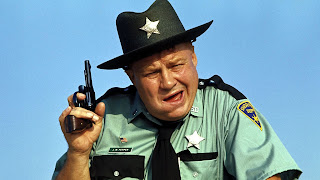
              
 “My office phone number is printed on the front, and I wrote my personal number on the back. Please keep this with you and make sure that I am the first person you call if you are ever pulled over for speeding or anything. You are new to Alabama and should know that not everywhere in this state is like Huntsville. If some redneck sheriff in South Alabama were to pull you over and run your name through the system, he might find the same information we did but I can guarantee you he won’t be as understanding. He's liable to beat the hell out of you and throw you in a cell. I’ve noted the mix-up on your file, but he might not find that until the next day or so and we don’t want that to happen. Just call me if the need arises.”

               I shook his hand, thanked him again, and placed his business card in my wallet where it remained for at least the next ten years.

               Welcome to Alabama!

To learn more about me and my writing, please visit my website: www.lesjohnsonauthor.com


*Not her real name – I don’t remember it!


Monday, September 6, 2021

Isaac Asimov Presents The Great SF Stories: 16 (1954) - A Review


Isaac Asimov Presents The Great SF Stories: 16 (1954) - A Review

I’ve owned several volumes in this anthology series for years and, embarrassingly enough, never read them. A few weeks ago, I decided to remedy the situation and randomly pulled #16 from my bookcase and began reading. Why on Earth did I wait this long? The stories are amazing.

The volume opens with a story by Richard Matheson (who, by the way, wrote some of the best episodes of The Twilight Zone TV series) called, “The Test.” Though the storyline was somewhat predictable, the emotion of the characters nonetheless drew me in – and the ending was a real gut punch.

William Tenn’s contribution was “Down Among the Dead Men.” The story was imaginative and haunting – in more than one way. I am confident John Scalzi read the story before he wrote “Old Man’s War.” The plots are not the same, but…

Almost all of the stories were excellent. There were a few I’d read before, like “The Cold Equations” (tom Godwin) and “The Deep Range” (Arthur C. Clarke), but many I had not and should have. The best example was from Chad Oliver, an under-appreciated writer whose collective works are among the most creative of the Golden Age. I have thought about his fantasy-ish “Transformer” every day since I finished the book. 

There are great stories by Philip K. Dick, Damon Knight, Gordon R. Dickson, Algis Budrys, and more.


Sunday, April 18, 2021

Moonraker (by Ian Fleming) - A Review

Continuing my trend of re-reading books that I read so long ago that I don’t remember many details (or, sometimes, even the plot!), I just finished Moonraker. The first piece of advice I can give a reader is ‘ignore the movie of the same name.’ The second bit of advice is ‘put yourself in the time period in which it was written and remember the context.’ The third is, ‘hang on, you are in for a great read!’

Written less than a decade after the end of WWII, when nuclear weapons and long-range missiles were new, the developed countries of the world were desperately researching both because they felt that if they did not, then they would be easily taken over or destroyed should another world war break out. Such is the setting for the development of the Moonraker rocket occurring in the UK under the direction of multimillionaire patriot Hugo Drax. (A rich, self-made man endears himself to a country by using his fortune to build a new type of rocket that revolutionizes everything. Hmmm. This is too farfetched to ever be possible…)

The only action in the first part of the novel is a card game - a game of bridge, not poker, not a casino game like Baccarat Chemin de Fer, no, just bridge. Fleming finds ways to build up to the game that make the reader think the fate of the world, or at least the lives of key characters, will depend upon the outcome. The game itself is suspenseful with the outcome uncertain until the very end.

Fleming loves describing food, rooms, and women and weaves key story elements into complex sentences that at first seem like they will only be providing the setting. But you need to carefully read every word lest you miss an important detail. The story moves along nicely and culminates into a very James Bond-like ending that is extremely satisfying.

SPOILER ALERT: At the end of the novel, to my great surprise, Bond does NOT get the girl.

As a writer (though clearly not in the same league as Fleming), I noticed he did one irritating thing that is a major ‘no-no’ today – head jumping. In many scenes, the story is described from the point of view of multiple characters. At more than one point, I was confused as to who was perceiving what and had to re-read the previous paragraphs to get it right.

I highly recommend this book, the 3rd in the James Bond series of novels. I am glad I re-read it.

Sunday, January 17, 2021

Graphene Body Armor - Sooner Than Expected?

Having co-authored a book about graphene, I follow developments in the field fairly closely and when this headline appeared in my newsfeed, I took notice:

This Ultra-Thin Material Can Stop Bullets by Hardening Like a Diamond” (link below).

(What? This article about graphene did not appear in YOUR newsfeed? How is that possible? I thought we were all reading the same news? But that is the topic of another future blog…)

The gist is this: Scientists discovered that when two layers of single-atom-thick sheets of graphene (which is just carbon in a unique geometry) are impacted, they become harder than diamond, potentially stopping the passage of the impactor. Translation: When you fire a bullet at the two, ultra-thin, ultra-lightweight graphene sheets, it is (likely) stopped from passing through. They then postulate that this could be the basis of a whole new type of bulletproof vest or body armor that weighs no more than a normal shirt or undershirt. The stuff of science fiction becoming is becoming reality right before our eyes.

But it won’t stop there. The military uses are potentially endless: Better tank armor, more robust aircraft (from bombers, to fighters, to helicopters). What would happen if bullets or artillery shells were coated with similar graphene layers? Submarines?

Given that graphene is transparent, think about how robust your cell phone screen might become? What about your car windows or those on your home in hurricane-prone Florida? Dream on. Would-be entrepreneurs out there should get busy and begin making some of these a reality – create your own market.

To read the original article, go here: https://bigthink.com/paul-ratner/this-ultra-thin-material-can-stop-bullets-by-hardening-like-a-diamond


Wednesday, March 4, 2020

Beamed Energy for Space Exploration: Giant Leap or Incremental Steps?

Progress in space exploration and development used to come in “giant leaps.” Neil Armstrong’s “one giant leap for mankind” is perhaps the most well-known leap. As Armstrong stepped on the Moon for the first time, he was the living fulfillment of a decade-long endeavor that took us from barely being able to send someone into space all the way to sending multiple people to the Moon and back again. In 1977 the Voyager spacecraft were launched, taking us on a leap that gave us our first close-up looks at Jupiter and the planets beyond. Since then, we’ve achieved significant milestones of exploration and science, but, sadly, they’ve come at a much slower pace and few, if any, have achieved the status of being a giant leap. And that might not be a bad thing.

Giant leaps tend to be expensive and take many years to develop, fly, and achieve their goals—leaving them open to the vagaries of politics, changes in the economy, and the whims of those who fund them. So, what about the alternative? Is the incremental approach better or at least more sustainable?

For my answer to the question and the rest of the story, click over to the Baen.com website where my article is featured for the month of March 2020.

Tuesday, January 1, 2019

Furloughed from NASA Again

UPDATE: January 1, 2019

It is amazing how little has changed since I wrote my 2013 blog post about being a furloughed NASA employee (see below).  I am again furloughed because a different president and Congress cannot agree on a budget.  I fear this shutdown/furlough will last much longer than any other I've experienced due to the polarizing nature of the core issue being debated.  It is important to note that funding for NASA (and many of the other parts of the government affected) have absolutely NOTHING to do with the core issue.

Projects will be delayed, hardware delivery deadlines missed, and launch dates may slip.

Alas.

-----

October 1, 2013

Today I received my furlough notice from NASA.  Since my job isn’t considered “excepted,” in other words, since no one will be injured or die if I don’t report for work, then I am to remain at home until recalled to work after the Congress passes and the President signs some sort of budget or continuing resolution to keep the government running.  The fact that the government has shut down all non-essential operations should come as no surprise to anyone who hasn’t been hiding under a rock these last several days.

What may come as a surprise to many is the following statement from the letter I received informing me of what I can and cannot do during the furlough: “During the furlough, you will be in a nonpay, nonduty status. During this time, you will not be permitted to serve NASA as an unpaid volunteer.

How many federal agencies, for that matter, how many employers have to tell their employees “I’m sending you home without pay for an indefinite period of time and you are strictly prohibited from doing any work for the company/organization on your own time and without compensation?”  I dare say there are not very many people out there who would take forced, unpaid days off and continue to work for the company that sent them home.  Except at NASA.  And, yes, if it weren’t so explicitly stated, I would be one who would continue to work on my NASA projects at home, on my own time, and without compensation.  I am sure I wouldn’t be alone.

In a normal work week, I receive 1/3 of my average daily work-related emails after 5:00 pm.  Some of them are time stamped after 11:00 pm.  I find that the people I work with routinely work at home, on their own time, as a general rule of thumb.  I’m not just talking about the rushed deadline where everyone pitches in to make it happen.   I’m referring to the day-to-day business of NASA.

Did you know that NASA has routinely been named THE best place to work in government by its own employees for at least the last two years?  How many companies where the employees routinely work uncompensated overtime just to get the job done will then turn around and rate their company as a great place to work?  Not many.  Except at NASA.

Why?

Speaking only for myself, I’ll tell you why I think that’s the case.  We’re working on challenging projects with the goals of advancing our understanding of the universe around us, expanding humanity beyond the Earth so as to ensure the eventual survival of the species, and making the Earth a better place to live for all who inhabit it.  Yes, these are lofty goals and bold assertions.  They are what motivate me and have inspired me since I was a child.  We believe we’re making a difference in the world and we love doing it.

Are there NASA employees who are just punching the clock?  Yes.  But they are in the minority.  Most of us don’t dread Mondays.  Most of us would much rather be working than furloughed and I, for one, would keep working on some of my projects during the furlough if I were allowed to do so.

Les Johnson
Linked In - http://www.linkedin.com/in/lesjohnson1
Personal Website - www.lesjohnsonauthor.com